3 Way Ball Valve
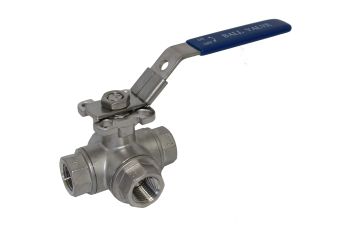
A three way ball valve is type of valve with 3-ports designed to regulate the direction of fluids in a piping system. This valve has a spherical ball with 3 port openings that can be rotated to direct the flow of the fluid from one port to another. 3-way ball valves are available in two different port configurations, the L-port and the T-port. Unlike a standard two way ball valve that only has two ports and simply opens or closes the flow, a three way ball valve features a T-shaped or L-shaped bore in its rotating spherical ball, that allows for multiple flow configurations, including diverting, mixing, or shut-off functions. These 3 way valves feature a blow-out proof stem that provides for additional safety and a locking mechanism on the handle that enables the valve to be locked in the chosen flow pattern. Constructed out of 316 stainless steel, they are corrosion resistant, making them ideal for use in chemical processing, hydraulic and HVAC systems, oil and gas, and for water treatment wherever flow redirection is needed. Three way valves are valued for their ability to redirect and control the flow of fluids, which simplifies complex piping systems, making them a valued component in fluid control applications.
- Threaded Connection: Female Threads x Female Threads x Female Threads
- Port: Reduced Port Valve (Standard Port)
- Pressure: Rated to 1000 PSI
- Seals: PTFE/Teflon
- Handle: Lever Type with Latch Lock (Blow Out Proof Stem)
- Sizes: 1/4" up to 2"

What is a 3 way valve?
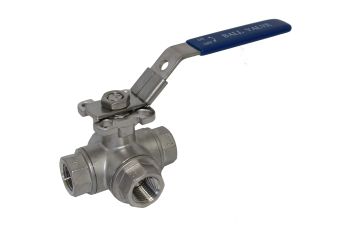
A 3-way ball valve is a type of valve with 3-ports that is used to direct and control the flow of fluid in a pipeline. They can be used to mix or divert fluids in plumbing and industrial systems and are sometimes called multiport ball valves or 3 port valves. It features a rotating ball with a T-shaped or an L-shaped bore which enables the flow to be directed into multiple configurations, such as joining two inlets into one outlet (mixing), diverting the flow, or shutting off the flow partially or completely. Unlike a 2 way valve that has 2-ports and simply opens or shuts off the flow, a valve 3 way has 3-ports and can direct the flow in a number of ways like mixing or combining flow, diverting or alternating flow and shutting off the flow in a number of directions.
How does a three way ball valve work?
A three way valve operation is initiated by turning the handle which rotates a spherical ball inside the valve to direct the flow of fluid through the three available ports. They have a spherical ball with openings or cut out channels in the shape of a T or an L, that control the flow direction of the fluid. As the ball is rotated the cut out channels align with the valves inlets and outlets, which directs the flow. To summarize, as the ball with openings is turned, it directs the flow from one port to another. This allows for the flow to be diverted to two different directions, or for the fluid to be mixed from two inlets into one outlet, depending on weather it is a T-port or an L-port valve. Three way valves can determine which path a fluid takes through a piping system.
2 way vs 3 way valves
The difference between a 2-way and a 3-way valve is in the number of ports they have. 2-way valves have two ports which allow them to open or close the flow of fluid, in effect they operate as a simple “on” or ‘off” switch. 3-way valves have three ports which allow them to direct the flow of the fluid. 3 way ball valves have two different functions depending on the type, they can either be used as mixing valves combining fluids from two different sources, or diverting valves directing fluids between one of two outlets. To summarize a 2-way valve is used mainly as a on/ off flow control, while a 3-way valve is used to mix fluids from two sources or to direct the flow into one of two directions. A 3 way valve is ideal if you are looking for a way to divert and control flow without the need for a pipe Tee and multiple valves.